Independent research, verified developments, and emerging scientific intelligence from the Genesis Mission ecosystem.
Published November 7, 2026 · Genesis Intel Hub editorial briefing
Executive Summary
The U.S. Department of Energy's Genesis Mission is showing progress beyond its initial funding announcements, with developments in AI computing infrastructure, critical-mineral processing, and university-led scientific research.
This week's reporting highlights Argonne's expanding AI inference capabilities, Aclara's progress toward an AI-assisted rare-earth separation digital twin, and two University of Oklahoma research teams pursuing geothermal and quantum technologies.
Meanwhile, PNNL's Environmental Molecular Sciences Laboratory (EMSL) announced four campaigns involving autonomous biology, molecular modeling, and quantum computing. Their formal Genesis affiliation has not been established; they are included as related research.
Key Developments
01 · AI Infrastructure · November 4
Argonne expands scientific AI infrastructure for Genesis
Tara computing system at the Argonne Leadership Computing Facility. Image: Argonne National Laboratory. Original article and photograph.
Argonne expanded its AI Inference Service with Tara and Minerva, increasing capacity for more than 50 available AI models and agent-assisted scientific workflows.
Intelligence significance: Shared inference infrastructure can help research teams use advanced scientific models without operating separate computing environments.
Aclara and Argonne advance rare-earth digital twin development
Aclara reported completing and validating an initial rare-earth separation model with Argonne National Laboratory. A Genesis-selected effort involving Aclara, Argonne and Virginia Tech aims to develop an AI-supported dynamic digital twin.
Intelligence significance: The research could improve efficiency in critical-mineral processing. The dynamic twin remains proposed, not an operational result.
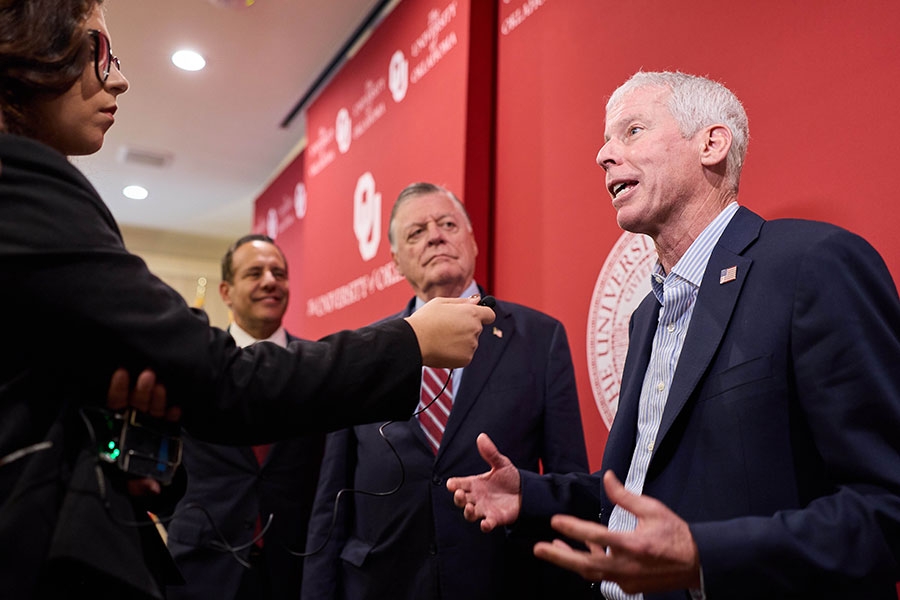
DOE Secretary Chris Wright speaks with media following the Genesis Mission roundtable, with Rep. Tom Cole and OU President Joseph Harroz. Photo: Travis Caperton / University of Oklahoma. Original article and photograph.
Two OU-led teams are pursuing AI-assisted geothermal modeling and quantum technologies, supported by nearly $1.4 million in Phase I funding. DOE leadership visited on October 30.
Intelligence significance: University teams add specialized capability to the Genesis research ecosystem in energy systems and quantum technology.
PNNL's EMSL announces four scientific AI research campaigns
EMSL introduced FY 2027 campaigns covering autonomous biology, molecular workflows, systems biology and quantum approaches to metal-binding molecules. Proposals are due December 1, 2026.
Intelligence significance: The initiatives emphasize reproducible scientific data, dependable autonomous experimentation and integrated workflows. GENESIS LINK NOT CONFIRMED.
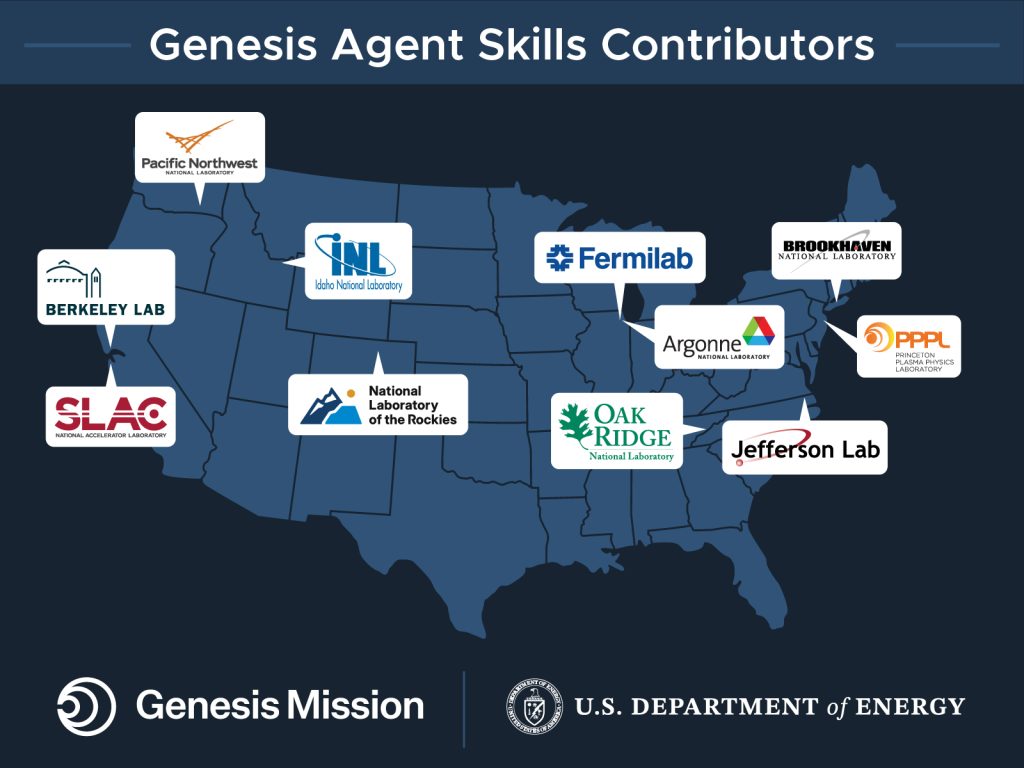
Genesis Agent Skills contributors across DOE laboratories. Graphic published in Fermilab's November 6 article. Original graphic and article.
Fermilab's November 6 article explains reusable tools for scientific AI workflows. The original DOE release was October 15; this is follow-up coverage rather than a newly launched program.
Model-serving systems and AI-agent workflows are becoming practical resources for scientific teams.
Applied research
Rare-earth separation demonstrates a potential industrial use for AI-enabled modeling.
Ecosystem expansion
Universities, laboratories and companies contribute complementary expertise to Genesis.
What to Watch Next
Research milestones: Verified deliverables beyond selection announcements. Infrastructure adoption: Active use of shared AI models. Industrial applications: Further validation of the Aclara dynamic twin. Partnerships: New formally documented university and industry participation.
Outlook
The Genesis Mission's long-term impact will depend not simply on funding levels or participating organizations, but on its ability to turn AI capabilities into measurable scientific and industrial results. This week's reporting provides early indicators of that transition, while distinguishing announced objectives from demonstrated outcomes.